

Overview: CRA Answers Practitioner Questions On The Modified Voluntary Disclosures Program
When the Canada Revenue Agency overhauled the Voluntary Disclosures Program (VDP) effective October 1, 2025, replacing Information Circular IC00-1R6 with IC00-1R7, it left tax practitioners with a long list of practical questions. How far back does a taxpayer really have to disclose? Does an automated CRA letter ruin a taxpayer's chance at full relief? Can a Voluntary Disclosures Program application and a Taxpayer Relief Program application be filed together?
On June 18, 2026, the CRA's Voluntary Disclosures Program manager answered these questions directly at a national webinar hosted by the Society of Trust and Estate Practitioners (STEP), alongside outside practitioner panellists. The CRA later published its written responses. For Canadian taxpayers considering voluntary disclosure, or already partway through one, these clarifications matter, because they resolve ambiguities that could otherwise mean the difference between full relief and a denied application.
Background: The Shift From IC00-1R6 To IC00-1R7
Before October 1, 2025, the VDP sorted applications into a General Program and a Limited Program, with the Limited Program offering reduced relief for taxpayers whose non-compliance was considered more serious. IC00-1R7 replaced that structure with two new categories: unprompted and prompted applications. An unprompted application, made before the CRA has any specific knowledge of the taxpayer's non-compliance, is normally eligible for 100 percent penalty relief and 75 percent interest relief. A prompted application, made after the CRA has had some relevant contact with the taxpayer, is normally eligible for up to 100 percent penalty relief but only 25 percent interest relief.
IC00-1R7 also changed the documentation standard. Rather than requiring a taxpayer to document every year of non-compliance regardless of how far back it goes, the CRA now sets minimum documentation periods: six years for domestic income tax matters, ten years for offshore income or assets, and four years or reporting periods for GST/HST. A full walkthrough of these changes is available in our guide to the new VDP rules effective October 1, 2025. These changes were meant to simplify applications, but they also raised new questions about what "complete" actually means, and about how CRA classifies borderline conduct as voluntary, prompted, or not voluntary at all.
Key Issues And Findings From The CRA's Webinar Responses
The documentation minima are a floor, not a ceiling
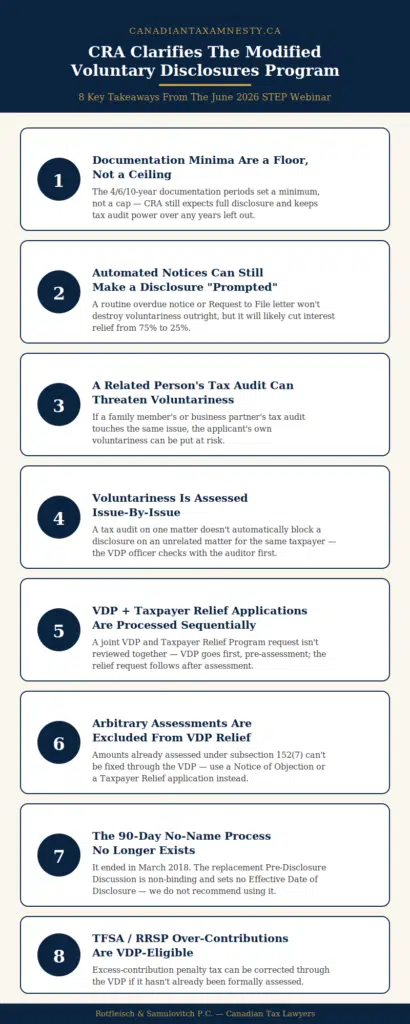
This question echoes one we have addressed before in the context of taxpayers with more than ten years of unfiled returns. Practitioners asked directly: if a taxpayer failed to report foreign income for 25 years but only documents the required 10-year minimum, can the CRA still pursue the other 15 years? The CRA's answer was unambiguous. The four, six, and ten-year periods are minimum completeness requirements, not a cap on what must be disclosed.
An applicant must still indicate whether the period of non-compliance extends beyond the minimum, even though it remains at the applicant's discretion whether to document those additional years in detail. Where a disclosure is otherwise consistent and reasonable, the CRA said it will generally rely on the information provided and will not expand the scope of the application. But the CRA also confirmed it retains full tax audit power over any years excluded from the application, with no VDP relief available for those years if CRA later reviews them, and an application can be denied as incomplete if the CRA requests additional years and does not receive them.
The documentation minima are separate from the statutory limit on relief itself
Separately from the four, six, and ten-year documentation minima discussed above, subsection 220(3.1) of the Income Tax Act, and the parallel provision for GST/HST, section 281.1 of the Excise Tax Act, cap the Minister's discretion to grant relief to a tax year, or GST/HST reporting period, that ended within the ten calendar years before the calendar year of the application. In practice this rarely creates any tension with the documentation minima, since six years for domestic non-compliance and ten years for foreign-sourced non-compliance both already fall inside this ten-year statutory window.
An automated notice does not necessarily make an application involuntary, but it can make it prompted
The distinction between "voluntary" and "prompted" caused real confusion among practitioners, since a disclosure can apparently be both. The CRA explained that voluntariness turns on whether a tax audit or investigation has been initiated regarding the disclosed issue. A system-generated overdue notice, on its own, normally does not destroy voluntariness. However, that same notice will likely still cause the application to be classified as prompted, which reduces the available interest relief from 75 percent to 25 percent.
The CRA drew a similar line for a standalone Request to File letter for a T1, T2, or T3 return: it does not disqualify a taxpayer outright, but it will most likely be treated as prompting the disclosure, since it identifies a specific filing obligation and a deadline.
A related person's tax audit can put voluntariness itself at risk
The CRA confirmed that an application is not voluntary if a tax audit or investigation has already been initiated against the taxpayer or a related taxpayer regarding the information being disclosed. Where the related person's enforcement action concerns issues directly connected to the applicant's own non-compliance, voluntariness may be at risk. That said, once voluntariness is established, the CRA said it generally only considers communications sent to the applicant, not to the related taxpayer, when deciding whether the resulting relief is at the prompted or unprompted level.
Voluntariness is assessed issue by issue, not across the taxpayer's entire file
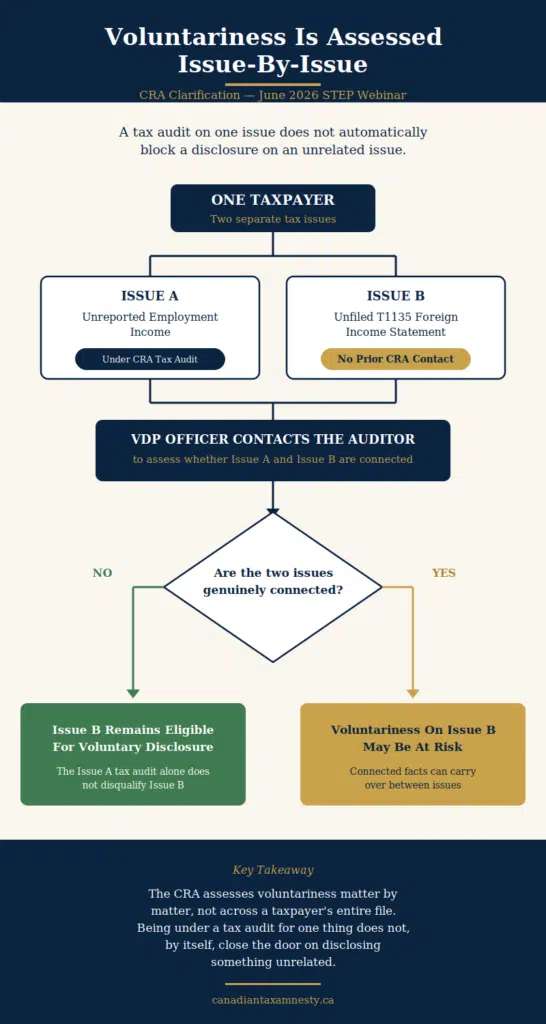
The CRA also clarified that an existing tax audit does not automatically shut the door on every other disclosure a taxpayer might want to make. Voluntariness is assessed on an issue-specific basis rather than at the taxpayer level, so a taxpayer under a tax audit for one matter, such as unreported employment income, can still make a valid voluntary disclosure on an unrelated matter, such as a previously unfiled T1135 Foreign Income Verification Statement.
In practice, the VDP officer assigned to the file will reach out to the auditor handling the existing tax audit to assess whether the two matters are connected. Where they are genuinely unrelated, the tax audit on one issue does not prevent relief on the other.
"Practitioners used to assume one CRA tax audit closed the door on everything else. This webinar confirms that isn't true, and that distinction can be the difference between full relief and no relief at all on an otherwise clean disclosure."
— David J. Rotfleisch, Certified Specialist in Taxation Law (Law Society of Ontario)
There is no such thing as an applicant self-declaring prompted or unprompted
One practitioner asked what happens if a disclosure is submitted believing it to be unprompted, but the CRA later discovers an old Request to File letter the taxpayer never received. The CRA's response reframes the entire question: an applicant does not characterize its own disclosure as prompted or unprompted. That determination is made by the CRA based on its review of the facts and any relevant CRA correspondence, so there is no "reclassification" in the sense practitioners might expect. This makes it important for a Canadian tax litigation lawyer preparing a disclosure to review all prior CRA correspondence with the client before submission, since undisclosed history can surface later and affect the outcome.
A joint VDP and Taxpayer Relief Program application is processed sequentially, not together
The Voluntary Disclosures Program and the Taxpayer Relief Program (also called the fairness program) operate at different stages of the assessment process. The VDP is a pre-assessment program: an application must be filed before a formal assessment is issued. The Taxpayer Relief Program reviews requests for penalty and interest relief after an assessment exists. The CRA confirmed that where a taxpayer submits both requests together, the VDP application is assessed first, and only once an assessment is issued does the Taxpayer Relief request move forward for independent review by the department responsible for handling it.
The VDP does not undo an existing arbitrary assessment
A taxpayer who failed to file returns for years, and for whom the CRA has already completed arbitrary assessments under subsection 152(7) of the Income Tax Act, cannot use the VDP to obtain relief on amounts already assessed. IC00-1R7 excludes relief on penalties or interest that have already been assessed. The correct route for those specific amounts is a Notice of Objection or an application under the taxpayer relief provisions (IC07-1R1), not the VDP. Our guidance on unfiled tax returns and arbitrary assessments covers how these assessments arise and how the 90-day objection deadline works.
The 90-day no-name process is gone; we do not recommend its informal replacement
The former process, in which a practitioner could submit an anonymous description of a client's situation and had up to 90 days to identify the taxpayer and provide documents, has not existed since IC00-1R6 took effect in March 2018. What the CRA now offers instead is the Pre-Disclosure Discussion, an informal, non-binding conversation with a VDP officer that gives a general sense of eligibility. Unlike the old no-name process, a Pre-Disclosure Discussion does not establish an Effective Date of Disclosure and does not create a case number, and nothing said in it binds the CRA.
We do not recommend using a Pre-Disclosure Discussion under any circumstances. It creates a record of contact with the CRA about a taxpayer's situation without securing any of the protection a taxpayer is actually looking for, since only a complete application identifying the taxpayer locks in an Effective Date of Disclosure. Taxpayers are better served going directly to a complete, properly prepared application with the help of a Canadian tax lawyer.
Non-consecutive years of non-compliance belong in one application
Where a taxpayer's compliance gap is broken up, for example, properly filed returns in some years within the relevant period but missing T1135 forms or unreported income in others, the CRA confirmed that all non-compliant years should be included in a single VDP application. Years within the required look-back period that have no errors or omissions are simply excluded; a single Effective Date of Disclosure applies, and relief applies to each disclosed year subject to the limitation periods under subsection 220(3.1).
The policy in effect on the date CRA receives the application governs
Applications submitted close to the October 1, 2025 transition date are governed by whichever policy was in effect on the date the CRA actually received the application, not the date the underlying non-compliance occurred or the date of any earlier contact with the CRA. Applications received before October 1, 2025 are processed under the former IC00-1R6, with no automatic right to elect into the new framework.
Estates and incomplete records: reconstruction is permitted, with a documented methodology
For an estate trustee who cannot access the deceased's full tax records, the CRA confirmed that IC00-1R7 paragraph 29 explicitly permits income reconstruction where records are incomplete. The trustee should use whatever bank statements, investment records, T-slips, or third-party correspondence are available, obtained where necessary through a representative request to the CRA, and explain any limitations in a cover letter accompanying Form RC199. Rather than testing the waters with a Pre-Disclosure Discussion, which we do not recommend, the trustee is better served working directly with a Canadian tax lawyer to build a complete, properly documented application from the outset.
TFSA and RRSP over-contribution penalties are VDP-eligible
The CRA confirmed that excess TFSA and RRSP contributions can be addressed through the VDP where the associated penalty tax under the Income Tax Act has not yet been formally assessed, and the voluntariness conditions are otherwise met. For background on how these penalties accumulate, see our discussion of TFSA over-contribution tax and penalties.
Related corporate or trust non-compliance does not have to be resolved first
A trust with missed filings does not need to wait until an associated but separately owned corporation becomes fully compliant before filing its own VDP application. Each taxpayer entity is assessed independently. The trust's application must still be complete with respect to the trust's own non-compliance, including related-party transactions with the corporation that are material to the trust's tax position, but the corporation's separate compliance issues may warrant a separate VDP application of their own.
CRA will not commit to a processing timeframe
Asked twice about typical processing times, the CRA gave the same answer both times: IC00-1R7 sets no formal service standard, and the CRA does not publish median processing times. An applicant can generally expect acknowledgment of receipt and an assigned Effective Date of Disclosure within a few weeks, but final decisions depend on the complexity of the file and whether CRA specialty areas need to weigh in.
Practical Implications For Canadian Taxpayers
For a taxpayer weighing whether to come forward before the CRA does, our earlier analysis of why the VDP is better than waiting for a CRA tax audit remains directly relevant. The throughline across these clarifications is that CRA correspondence, even correspondence that looks routine, carries more legal weight than it might appear to at first glance.
An overdue notice, a Request to File letter, or a tax audit against a related family member or business partner can each affect the level of relief available, even where none of them amounts to a full CRA tax audit file being opened. Waiting for a formal letter before acting is a risk, not a safe strategy, since by the time that letter arrives, the window for unprompted relief may already be closing.
The clarification on documentation minima also has a practical bite. A taxpayer cannot treat the six, ten, or four-year window as a way to quietly leave older non-compliance out of an application. The CRA expects the applicant to disclose the true extent of the problem, even while only being required to document the minimum period in detail, and the CRA's ongoing tax audit powers over excluded years mean that gamble rarely pays off.
For taxpayers dealing with an existing arbitrary assessment, an over-contributed TFSA or RRSP, a messy estate, or non-compliance spread across an entity structure, the takeaway is that the VDP remains flexible on how a disclosure is built, but not on what it must ultimately disclose.
"The gap between an unprompted and a prompted application can decide whether a client keeps 75 percent of their interest charges or only 25 percent, and these clarifications show just how easily an application can slide from one category to the other."
— David J. Rotfleisch, Certified Specialist in Taxation Law (Law Society of Ontario)
Takeaway
The CRA's June 2026 webinar responses do not change the substance of the overhauled Voluntary Disclosures Program, but they narrow the room for guesswork. Documentation minima are floors, not caps. Routine-looking CRA correspondence can quietly convert an application from unprompted to prompted. A related person's tax audit can jeopardize voluntariness even where the applicant has done nothing wrong. And several older tools practitioners relied on, including the 90-day no-name process, no longer exist in the form they remember. Taxpayers considering a voluntary disclosure should treat these details as part of the analysis, not as footnotes.
Pro Tax Tips
Before assuming an application will qualify as unprompted, a taxpayer should have an experienced Canadian tax lawyer review every piece of CRA correspondence received in the relevant period, including anything that looks automated or routine, since the CRA's own guidance confirms that this kind of contact can still convert a disclosure into a prompted one.
Where the non-compliance extends beyond the minimum documentation period, the safer course is to disclose that fact explicitly rather than letting the application appear complete when it is not, since an incomplete application can be denied outright and the CRA retains full tax audit power over any years left out. We do not recommend using a Pre-Disclosure Discussion under any circumstances, including for estates with incomplete records or for taxpayers connected to a related person already under CRA review, since it does not lock in an Effective Date of Disclosure, creates no binding protection, and puts a taxpayer's situation on the CRA's radar without securing anything in return.
A complete, properly prepared application filed directly is the better course in every case. Where a taxpayer already has an arbitrary assessment on file, or has related entities such as a trust and a corporation with separate compliance gaps, mapping out which relief mechanism, whether that is the VDP, a Notice of Objection, or the Taxpayer Relief Program, applies to which amount is essential before anything is filed, because filing the wrong mechanism for a given amount can foreclose the right one.
Frequently Asked Questions
What did the CRA clarify about the Voluntary Disclosures Program in 2026?
At a June 18, 2026 webinar hosted by STEP, the CRA answered 21 practitioner questions about how IC00-1R7 works in practice, covering documentation minima, the prompted versus unprompted distinction, joint applications with the Taxpayer Relief Program, arbitrary assessments, estate disclosures, and more.
Are the VDP's four, six, and ten-year documentation periods a hard limit on what the CRA can review?
No. The CRA confirmed these periods are minimum completeness requirements, not a cap on scope. The CRA retains full tax audit power over any years excluded from an application, and no VDP relief is available for those years if they are later reviewed.
Does an automated CRA notice make my voluntary disclosure application prompted?
It can. The CRA said a system-generated overdue notice normally does not destroy voluntariness on its own, but it will likely cause the application to be treated as prompted, reducing available interest relief from 75 percent to 25 percent.
Can I still apply under the VDP if the CRA sent me a letter asking me to file a return?
Generally yes, but a standalone Request to File letter for a T1, T2, or T3 return will most likely cause the disclosure to be assessed as prompted rather than unprompted, since it identifies a specific filing obligation and deadline.
What happens if a related person, such as a family member or business partner, is under a CRA tax audit?
It can put the applicant's own voluntariness at risk if the related person's tax audit concerns issues directly connected to the applicant's non-compliance. Where voluntariness is not in question, the CRA said it generally only looks at communications sent directly to the applicant when deciding whether the application is prompted or unprompted.
Does an existing CRA tax audit on one issue stop me from disclosing an unrelated issue?
Not necessarily. The CRA assesses voluntariness on an issue-specific basis rather than across a taxpayer's whole file. A taxpayer under a tax audit for unreported employment income, for example, can still make a valid disclosure for an unrelated, previously unfiled T1135. The VDP officer will typically confirm with the auditor whether the two matters are actually connected before proceeding.
Can I submit a joint Voluntary Disclosures Program and Taxpayer Relief Program application?
Yes, but the CRA processes them separately and sequentially. The VDP application is reviewed first, since it operates before a formal assessment is issued, and the Taxpayer Relief request is only forwarded for review once that assessment exists.
Is the Voluntary Disclosures Program available for tax debt the CRA already assessed through an arbitrary assessment?
No. IC00-1R7 excludes relief for penalties or interest that have already been assessed under subsection 152(7) of the Income Tax Act. Those amounts must be addressed through a Notice of Objection or a taxpayer relief application instead.
Can I still request an anonymous, no-name voluntary disclosure?
No. The former 90-day no-name process ended when IC00-1R6 took effect in March 2018. The CRA now offers a Pre-Disclosure Discussion instead, an informal, non-binding conversation that does not establish an Effective Date of Disclosure. We do not recommend using it under any circumstances, since it puts a taxpayer's situation in front of the CRA without securing any actual protection. Filing a complete, properly prepared application directly is the better approach.
How long does the CRA take to process a VDP application?
The CRA has not published a service standard or a median processing time. Applicants can generally expect acknowledgment of receipt and an assigned Effective Date of Disclosure within a few weeks, with final decisions depending on file complexity.
Can excess TFSA or RRSP contributions be corrected through the Voluntary Disclosures Program?
Yes, where the associated penalty tax has not yet been formally assessed and the disclosure otherwise meets the voluntariness requirements.
Can I include multiple non-consecutive years of non-compliance in one VDP application?
Yes. The CRA confirmed that all non-compliant years within the relevant look-back period should be included in a single application, with compliant years simply excluded and one Effective Date of Disclosure assigned to the whole application.
How does the statutory 10-year limit on relief interact with the documentation minima?
Subsection 220(3.1) of the Income Tax Act caps relief to a tax year that ended within the ten calendar years before the year of the application. In practice this rarely comes up as a separate issue, since the documentation minima described above (six years domestic, ten years foreign) already fall inside that ten-year window.
Which VDP policy applies if I file close to the October 1, 2025 transition date?
The policy in effect on the date the CRA actually receives the application governs, not the date the non-compliance occurred. Applications received before October 1, 2025 are processed under the former IC00-1R6.
Can an estate trustee use the VDP if the deceased's records are incomplete?
Yes. The CRA confirmed that income reconstruction is permitted where records are incomplete, using available bank statements, investment records, T-slips, or third-party correspondence, provided the trustee documents the methodology and explains any limitations in a cover letter with the application.
DISCLAIMER: This article provides broad information. It is only accurate as of the posting date. It has not been updated and may be out-of-date. It does not give legal advice and should not be relied on as tax advice. Every tax scenario is unique to its circumstances and will differ from the instances described in the article. If you have specific legal questions, you should seek the advice of a Canadian tax lawyer.